
How SimpleSafe safeguards your organization's data and incident documentation across the platform.
SimpleSafe is built on enterprise-grade cloud infrastructure with a security-first architecture: customer data is isolated by organization, access is denied by default, and every automated process authenticates with short-lived credentials rather than stored secrets. The summary below reflects the controls in place across the SimpleSafe™ platform.
The platform runs on Google Cloud (Firebase). All data is encrypted in transit (TLS) and at rest by default using Google-managed encryption, inheriting Google Cloud's physical, network, and infrastructure security.
Each organization's data is logically isolated from every other tenant. Database rules are deny-by-default — no record is reachable unless access is explicitly authorized for that specific account. Isolation is enforced at the data layer and verified.
Backend automations authenticate using short-lived service-account tokens (roughly 30-minute lifespan), not static passwords or shared keys. No long-lived downloaded credential files exist anywhere in the environment.
A single, least-privileged service identity handles backend operations, scoped only to what it needs. Keys are rotated on a defined cadence, authentication is monitored, and unused accounts and credentials are retired.
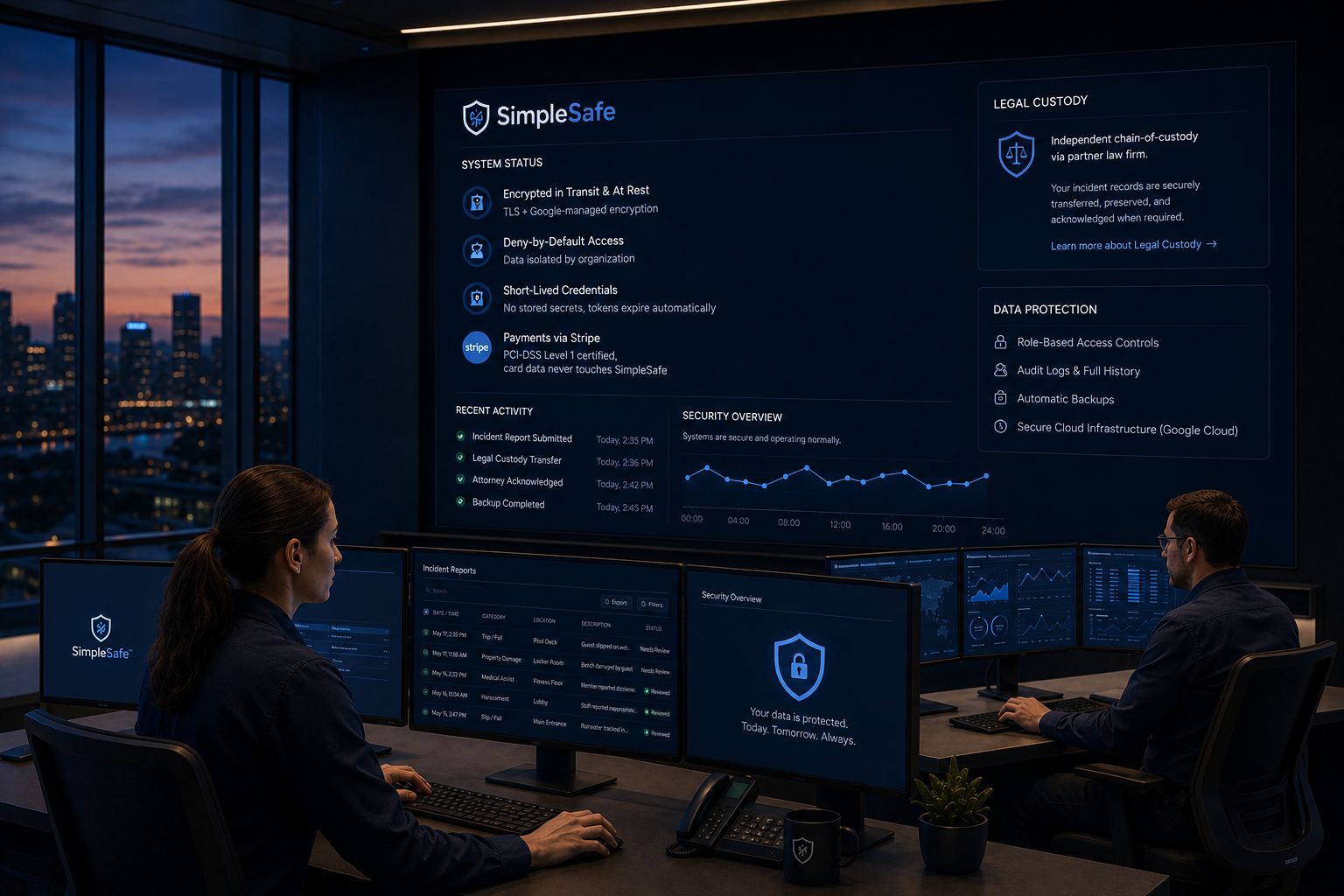
Incident documentation captured through SimpleSafe is transmitted in real time to an independent Dallas-based premises-liability law firm that acts as legal custodian, returning a timestamped acknowledgment of receipt. This establishes a verifiable record outside your organization's own systems from the moment an incident is logged — supporting insurance and legal defensibility in a way standard documentation tools do not.
SimpleSafe is glad to complete vendor security questionnaires (SIG, CAIQ, or your own format) and provide additional documentation on request. If your organization requires specific assessments or evidence as part of onboarding, we'll work with your team to provide what you need.
A one-page summary you can share with your security or risk-management team.